
Steel hardening is a metallurgical process in which the internal structure of the material is altered to increase hardness and wear resistance. The process is used when components need to withstand high surface loads, rolling contact or cyclic fatigue. For companies working with transmissions, shafts or machine components, the right hardening strategy helps define performance and service life already during manufacturing.
Structural changes in steel
When steel is heated above its critical temperature, ferrite and pearlite transform into austenite. Austenite is a phase that can dissolve more carbon than ferrite. During rapid cooling, the carbon does not have time to diffuse back. The structure is then transformed into martensite.
Martensite is hard and wear-resistant, but also brittle. For this reason, steel hardening is almost always followed by tempering. Tempering reduces internal stresses and improves toughness without unnecessarily reducing hardness.
Carbon content and hardenability
Not all steel grades respond in the same way. Carbon content determines the potential for martensite formation. Below approximately 0.2% carbon, the effect is limited. Between 0.3% and 0.6%, good hardenability is generally achieved. Alloying elements such as chromium, molybdenum and manganese affect transformation rates and depth of hardening.
When hardening steel, material selection and process parameters must therefore be analysed together. Excessive cooling rates can cause cracking, while insufficient cooling may result in bainite or pearlite instead of martensite.
Through hardening and surface hardening
Through hardening means that the entire cross-section is transformed into martensite. The method is used when the component must withstand high loads throughout the material.
Surface hardening means that only a defined layer is transformed. The core remains tough and can absorb bending stresses and impact loads. For gears, shafts and bearing races, this is often the more functional solution.
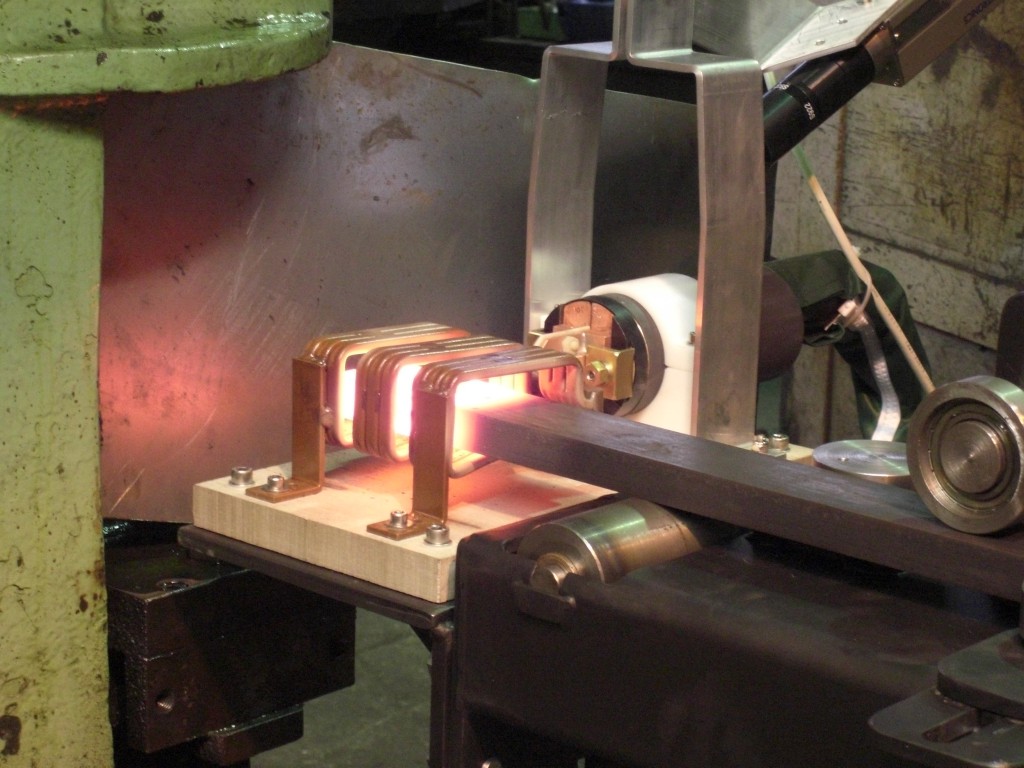
Controlled local heating is therefore a technical advantage. With induction hardening, heat is generated directly within the material and the heating zone can be defined with high precision. This enables accurate control of the hardening depth and reduces distortion.
Read more about how we use induction hardening for industrial surface hardening of steel components.
Consequences of incorrect hardening
Incorrect steel hardening can result in:
- Insufficient wear resistance
- High residual stresses
- Distortion
- Reduced service life
In series production, the effects of small variations become more significant. A deviation in temperature or power directly affects the microstructure. Repeatability and process control are therefore essential technical requirements.
Induction-based heating makes it possible to control power, frequency and heating rate with high precision. Heating takes place quickly and locally, reducing the impact on surrounding material and lowering energy consumption.
Steel hardening in a production environment
When heat treatment is integrated into the production line, cycle times can be shortened and quality assurance improved. Process data can be recorded and monitored, providing traceability and long-term process stability.
We develop and supply induction-based systems for heating and hardening steel components. Our approach is based on the behaviour of the material, the function of the component and your production environment.
Would you like to analyse how your current hardening process affects component performance and service life? Contact us for a technical review and discuss how induction-based hardening can strengthen your production process.