
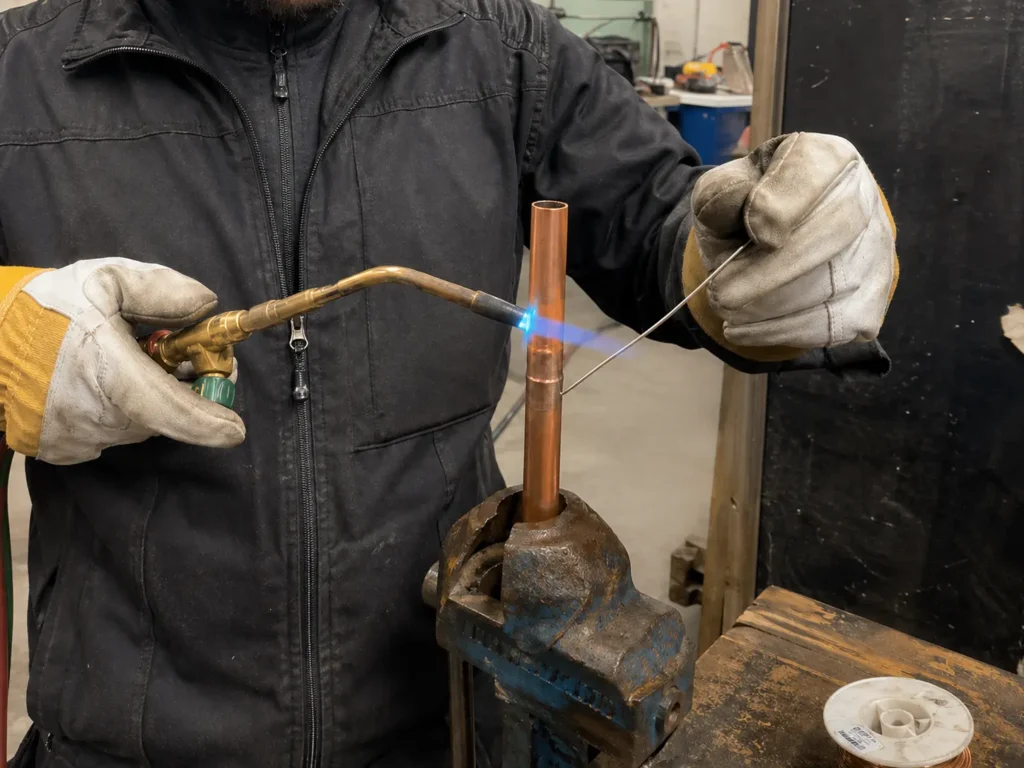
Gas brazing is an established method for joining metals where heat from a gas flame is used to melt a filler metal. The method is used in areas such as pipe installations, service work, repairs and metalworking. It is used when two or more metal components need to be joined without melting the base material in the same way as in welding.
In industrial environments, where the same brazed joint must be repeated many times and where consistent quality is essential, the choice of heating method becomes more important. In these cases, induction brazing can provide better conditions for process control, repeatability and integration into the production flow.
What is gas brazing?
Gas brazing involves using a torch to heat the area where two or more metal parts are to be joined. Once the correct temperature has been reached, the filler metal is applied. It melts, flows into the joint and forms a solid bond as it cools.
Unlike welding, the purpose is normally not to melt the base material. Instead, the joint is created as the filler metal bonds to the material surfaces. This makes the method useful for components where a tight and strong joint is required with limited impact on the base material.
The method is used for both soft soldering and brazing, depending on temperature requirements and the load the joint must withstand.
How does the process work?
During gas brazing, the flame is directed at the joint until the material reaches the correct working temperature. The filler metal is then added. If the surfaces are clean, the temperature is correct and the filler material is suitable for the base material, it melts and is drawn into the joint by capillary action.
Capillary action causes the molten filler metal to spread through the narrow gap between the components. For this to work correctly, the joint clearance must be properly controlled. Variations in joint geometry or temperature can affect how well the filler metal fills the joint.
Flux is also used for many materials. The flux helps prevent oxidation during heating and improves contact between the filler metal and the base material. Inadequate cleaning, incorrect temperature or unsuitable material selection can reduce joint quality.
Equipment and Practical Requirements
Gas brazing requires equipment suited to the material, joint type and temperature requirements. Common components include gas torches, gas cylinders, nozzles, filler metals, flux and personal protective equipment.
LPG is often used for simpler tasks, while acetylene combined with oxygen provides higher temperatures and greater control for more demanding applications. The choice of gas affects heating speed, temperature and process control.
Because heating is carried out with an open flame, workplace safety must also be considered. Ventilation, fire protection and the handling of flammable gases need to be planned and controlled.
Materials and Applications
Gas brazing is often used for copper and copper alloys, such as brass, but it is also used for steel and stainless steel depending on the choice of filler metal and flux.
A common application is copper piping in heating, ventilation and sanitary installations as well as refrigeration systems. In these applications, leak-tightness and correct execution are essential for performance and service life.
In industry, the method is mainly used for repairs, assembly and smaller production runs. In recurring production, however, it is important to assess whether the process provides sufficient control over temperature and results.
Limitations in Production Environments
When brazing needs to be repeated many times, gas brazing can present certain limitations. Since heating is carried out manually with a flame, the process is highly dependent on the operator.
Temperature, heating time and heat zone are controlled indirectly, which can make it more difficult to achieve the same result over time. This can affect both joint quality and cycle times, especially in production where variation has consequences for function and subsequent process steps.
When requirements for repeatability, documentation and automation increase, these factors become increasingly important.
When Does Induction Brazing Become an Alternative?
In production environments where brazing needs to be controlled, repeatable and integrated into a process flow, induction brazing is often used as an alternative to gas flame heating.
With induction brazing, heat is generated directly in the material using an electromagnetic field. The heating can be focused on a specific area of the component and controlled in terms of power, time and temperature.
This provides better process control and makes it possible to achieve consistent quality even at high production volumes. At the same time, cycle times can be optimised and the process integrated into automated systems.
The difference becomes particularly clear when the same brazed joint has to be produced repeatedly. While gas brazing depends heavily on manual handling, induction provides a more predictable and reproducible process.
Choosing the Right Method
The choice of brazing method should be based on an overall assessment of the component, material and production requirements. Factors such as joint geometry, strength requirements, production volume and the need for process control all influence which method is most suitable.
Gas brazing is often a suitable option for manual work, service and smaller production runs. When requirements for precision, repeatability and efficient production increase, induction brazing can provide better conditions.
Induction Brazing in Industrial Applications
Incoil works with induction-based heating for industrial brazing processes where heat needs to be applied locally, in a controlled manner and with high repeatability. The focus is on applications where the process must remain stable over time and be integrated into a production flow.
By analysing the material, joint geometry and production volume, it is possible to determine when induction brazing can replace or complement gas brazing.
Contact us if you would like to discuss a specific application or receive a technical assessment of which method is most suitable.